
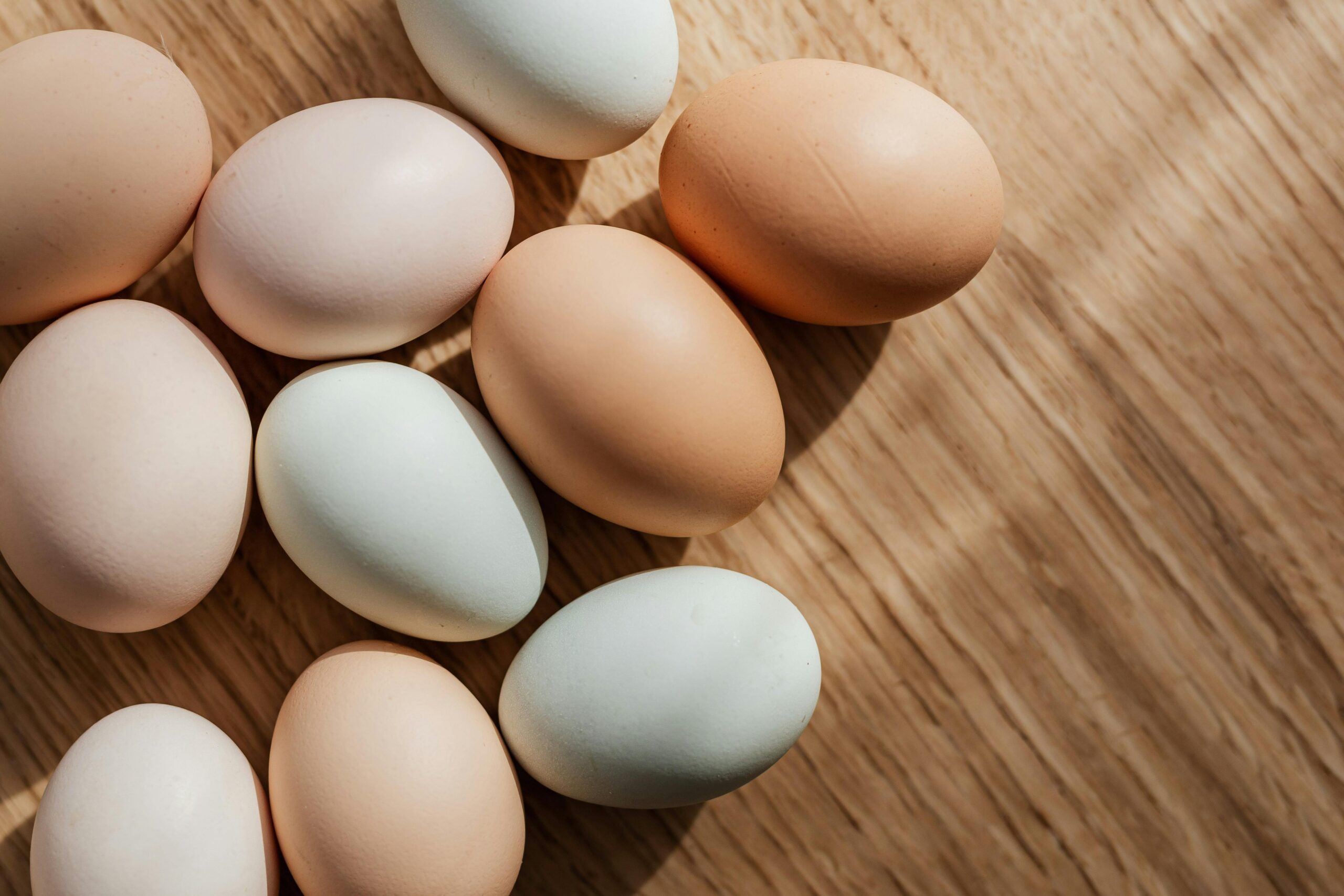
AT BREAKFAST THIS MORNING, I set the eggs on the counter and then stared a moment at the carton—brooding, I suppose. A dozen eggs always puts me in mind of fundamental things: whole notes or stony beaches, colored rings in a newborn’s crib. When I raise the lid, the twelve smooth domes seem kin to the idealized illustrations of neutrons or protons—those unnumbered pool balls racked up as carbon or boron in my elementary school encyclopedia. When I was little, I used to shred construction paper and then hold the fibers up to the light, searching for the source of the place where my drawn dinosaurs lived. I still remember those fibers, though on closer inspection, imagination presents no billiard balls orbiting about as they had in those educational films of the 1960s. Rather, it gives me eggs, long strings of them peacefully arranged like DNA in their gray cartons of protein. The implication is that the universe is fragility and nourishment all the way down. Well, something inside of me craves the fact of that, for we are in troubled times, and eggs are very much on my mind.
Easy over at risk! Chickens in the news; the sky that most of them will never see is truly falling down. Bird flu, H5N1, has made a sacrificial abattoir of our egg factories; more than twenty million casualties in the first quarter of 2025 alone—and still no resolution in sight. With both government and economy in disarray, “the price of eggs” has become the phrase we use for everything that is now so difficult to afford. Our anxiety has found a home in the image of an egg. In any case, we have not been kind to chickens, having gone with such cool efficiency from henhouses to “mass confinement systems,” and that unkindness has come home to roost. Meanwhile, at the federal level, we are undergoing a parallel degeneration. It’s as if the current administration has taken a lesson in governance from the heads of industrial agriculture. Indeed, as I read about ICE, mass deportations, private prisons, I find it hard to tell where the chicken warehouses leave off and the human ones begin. The celebration of our teeming variety, so luminously expressed by Walt Whitman and Emerson, has been momentarily eclipsed by a charred rock. The extremists among us—human beings, let me never forget—are dismantling our beleaguered democracy, and their sole concession to the egalitarian spirit is heartlessness. Our best chance to overcome their efforts is a grassroots fight, already underway. Count me in. Well, with so much at risk and so much to do, the simple fact of an egg is a fortifying meditation. I reclaim a little heart by pondering the promises eggs offer: all that may be born; all that may be reborn.
When I got out of college in the mid-1980s, I fell in with a bunch of artists. We were all working in a three-story restaurant that served mostly eggs. The place was cramped, with two tiny kitchens, one up high, the other down low, and a vibrant staff throughout—all of us working elbow to elbow, waiters hauling out plates of omelets and fried potatoes, poached eggs and quiche, eggs Benedict or Florentine, all bound for people seated at little marble tables, each table with a carnation or hydrangea propped in a slender vase.
Some customers would touch the petals and then shiver with pleasure to discover they were real. Sundays were a madhouse, with people lined up outside and the plate glass windows fogged halfway to the ceiling. In the tight kitchens, the cooks nearly danced as they worked, dropping the oven door with their feet, pivoting to garnish omelets, shouting to a delayed waiter with a broken yolk—make it look like the toast did it! As a cook, I was tasked to produce the “egg juice,” as we called it, a duty that involved cracking hundreds of eggs, three-hundred and sixty to a case, seven hundred and twenty at a time. A single egg in each hand, I’d tap both shells to a plastic rim and then shake loose each yolk in its sock of albumen, my ears registering the satisfying puh-lump as each glob hit the rising juice. The cases emptied, I’d jab a whisk into the bucket and pump the handle like a butter churn, joggling that lumpy fluid into a lively froth.
All around me, the heat and steam smelled like the crew I worked with, mostly people who cared extravagantly about impractical things, such as the quality of light or how to express something on a stage, or to say no to the unconscionable things that a country was doing, out of sight, with its money; people who extravagantly loved and hurt one another at that crazy thrown-together time of life. Back then, we found ourselves at the start of the Reagan years, and were uneasy about this palpable change in the progressive spirit of our leadership, this vindicating “Morning in America,” the first visible frizzling away of what the Civil Rights Act had wrestled up out of the New Deal. Where were we headed? Well, we went on to push back, threw ourselves against what this new order delivered: deregulation, trickle-down economics, the unsavory deceptions of the Iran-Contra Affair. On the CBS Evening News, we watched the pageantry of authority present itself as orderly and truthful, as incontestable. By contrast, we offered our youthful insurgency, a motley of ferocity and vigor just out the gate of childhood. I recall the socialist newspapers on the bar top, the after-hours talk in the empty dining rooms, the gossip and calls for action, some actual action, and, Sunday after Sunday, eggs poured through it all. Though we were hardly organized, the generative seedbed that we were made resistance possible. In such confused and fertile places, all down the centuries, the end of every empire finds its beginning. At any rate, when I need inspiration, as I do now, I remember that vital place, a restaurant that served mostly eggs. I recall those vases on the tables, that the flowers were real.
When I was not cracking eggs, I traveled in a hobo sort of way. And out there on the road, my favorite time of all, my one splurge, was a diner breakfast enjoyed at leisure. Anywhere would do. After sleeping on the ground, usually in a field somewhere, I’d find me a Denny’s or a hole-in-the-wall place in some prairie town, and what a pleasure it was to sit in a booth with a mug and talk into my journal about the starry sky of the night before and all the big things that life had to offer. Hobo language, so poetic, rose colorfully to the happiness of those breakfasts; it was a lexicon that did right by eggs. When you’re young and hungry, nothing is quite so good as biddles, or, more amply, biddles with jam nuts, saddle blankets, pig’s vest with buttons, and a snail. As far as breakfast went, a favorite of mine was two eggs on toast—in hobo parlance, “Adam and Eve on a raft.” “Wreck ’em,” they’d say if you wanted ’em scrambled; “Eyes open,” if not.
Thirty years out from those travels as a younger man, I learned that I am, in fact, an older woman. A late-life surprise. And a whole new way to travel. Early in my transition, a new kind of journaling awaited me as I sat each morning with a mug and pondered the starry skies within me. I soon learned that when you find you’re trans, the way to talk about it is to say your egg cracked. In September 2020, mine certainly did. Yolk all over the place. The very first time I went out in a skirt, I met my childhood friend, Patrick, for breakfast. We met at a restaurant called, appropriately enough, The Egg & I. In a booth there, I laid out the experience of my cracked egg. I was not sure how he’d take it. After all, for sixty years he’d known me as a male, and we’d been raised together during an era when it was dangerous to admit you were gay, much less a girl in a boy’s body. In the mill town where I’d grown up, there were no words for what I was, no language to accommodate the woman who dreamed for years in the deeper parts of me. I came of age, as it were, a young man with a two-dimensional perspective living in the body of a three-dimensional woman I could not see. Meanwhile, back at The Egg & I, unsure of what to expect, I disclosed that I had a new name, and as I delivered it into the space between us, Patrick—looking increasingly pained, as if a thing in the world were no longer right—whipped out his phone and, before I could finish speaking ,was updating my name in his contacts. The waiter came over, and we both looked up. She set down our eggs.
I’ve noticed that twelve eggs on a quiet counter have a little of The Last Supper about them. Whenever I open a new carton, I can almost feel the presence of the Son of Man—da Vinci’s Jesus—presiding benignly over the spirit of all that nourishment. And more: the lifted lid, like that of a cedar chest, puts me in mind of hopes that sailed with steamer trunks across the Atlantic, or, yet again, the ceramic unity of coins and pearls heaped in the chest of a dentist’s aquarium. Thus, the carton suggests the accouterments and currency that enable the realization of a promise, and that same spirit is proffered all the way down to our existential common denominator manifest in the feminine receptivity of eggs. In their homely carton, the twelve seem to say, Let’s begin with the best of everything. Let’s begin with heart. Let’s say we’re all in this together. The dozen commiserate, revealing their pale yellow souls. Egg factories, they confess, are tough on mothers. They point out that the whole world is fragile, like an egg; it’s crazed, with ice breaking, fissures in the common good. Reach out, they say, rise up from the flower at your table and do the work of a good king’s horse in the face of a bad king’s men. They say the wisdom of authenticity will outmuscle the prevarication of fools. Here is the secret of Humpty-Dumpty: the rhyme ends inconclusively; hopeless as things look, nothing suggests that anybody stops trying to repair the damage. And what is the truth about eggs anyway—are they never to be broken? Is each one to be an Adam or Eve forever sealed in the dark, waiting for a raft? That’s just the thing about an egg. About all eggs. Fragile as they are, they know they’re made to be broken. So, wreck ’em! Or send ’em out, “eyes open,” into the storm. Trust ’em to wise up and learn how to fly. The fact of you is testimony.
This morning, for breakfast, I heated the skillet; to save money, I fried two eggs instead of the usual three. I stood over the pair luffing in butter, gave them a shake of salt, a twist of pepper, and as I regarded them all freckled up and so fresh from the store, it occurred to me that I’d do well to follow Walt Whitman, that “lonely old grubber,” right into Allen Ginsberg’s poem about a supermarket in California. Whole families shopping at night! Ginsberg says, What peaches, he reports, what penumbras! And who is that, he might have added, over in the refrigerated section, dreaming about eggs? The best of American poetry invites us to know and love this country; from our leaves of grass to our strong brown rivers, such poetry rises from the many shadows of this troubled land and alights, birdlike, within the complex canopy of honest celebration. How shall we open to the America we find ourselves in, so various and vibrant, so riven? How shall we do more than merely requite its loneliness?
And, so, all before eight o’clock in the morning, I encountered these many considerations—Ginsberg, hobos, and everything else—brought to me by a couple of eggs. Afterward, while cleaning up, I came back to the carton still open on the counter, now two eggs down from twelve. Those left seemed a bit subdued, meditative, as if they’d turned from the morning light to comfort their potential. I glanced at the clock—so much to do!—then closed the lid and put the carton back in the fridge. Every uncracked egg is an expression of grief.
Originally published: Orion Magazine online | May, 2025
Photo: kaboompics | pexels.com
0 Comments