
We never owned a cottage on a lake, though my parents knew plenty of people who did. In the years I was growing up, our family sometimes visited acquaintances on one lake or another, always arriving with extra food and towels and never lingering for more than a couple of days. “Lave while you’re still having fun,” my father instructed.
We had fun with a wide range of landed vacationers. There were the young families who owned boathouses full of water-skis and mismatched flippers, who always kept a basin at the back steps—set out in May and taken in at the end of the summer—in which we were made to march in place till our feet were rinsed of sand. Or else we were the guests of retired couples: the kindly wife in striped culottes who distributed Dixie cups and led us into the woods for blueberries, her white-haired husband who sported an admiral’s cap and gave tours of “his lake,” skimming along in a mahogany speedboat, a puckered taffeta flag riding low at the stern and snapping its yellow fringe.
As we traveled north to other people’s cottages my feelings always ran the same course, from excitement at home to boredom on the highway to a final mood more complex and mysterious. This last phase began when our station wagon left the highway and swung wide onto a lake road. All at once we were in a different world. Gone was the baked and weary face of the highway, with its effete streamers of weeds. The woods crept up the gullies and strobed us with shadows. The road went quaint, became a kind of lane, here dappled deep in the trees, there passing a field-stone gas station with its tall pumps and homemade “BAiT” signs. We entered roomy marshes, following a belt of tar through the cattails. Along the bank, powerlines bellied from pole to splintered pole, touchably low.
There were many forks. Most were marked by signs made to look like white arrows, some stacked thirty high, each with the name of a family cottage, a name that would reappear a few miles up the road—sometimes etched into an oval of lacquered pine, or maybe painted on a slab of black iron with a rosmaling of edelweiss and bluebirds. When we spotted our host’s sign, my father would steer us into the green-black wall and follow the dirt lane deeper into the trees. It was always a strangely solemn procession, the slowness of our station wagon complementing my sudden timidity, the air charged with the urgency of my mother’s last-minute ordering and gathering, with her admonitions about manners. Meanwhile, we children, the six of us, would sit hushed at the windows as we stared out at the woods, at the strange ferns and orange mushrooms that would soon be ours to investigate.
If the hosts had kids, we were formally introduced to one another, each side quietly facing the other like members of two little teams. Left alone, both sides soon forewent their shyness, the cottage-kids gaining confidence by showing us their wares, we through gratitude and delight. Kickboards! Pontoons! Tether balls!
The tours we used to get. Cottages, cottages, homey and homely, those rummages without a sale, those museums of fad. Here was the world of silly bar glasses, of dirt-dobbered thermometers and tall, green kitchens; here were the cramped, vaguely nautical bedrooms, the eclectic slop of furniture, the shelves of board games with the requisite shoe box full of dice, pawns, and red hotels. How strange it was, to be a child thrust into that anachronistic scramble, that clutter peculiar to a seasonal dwelling. All about me was a house that aped the presence of a home, yet its contents failed to coalesce, to blend into a single domestic landscape the way things do that are used year round. Not that such contents were unaccommodating when called upon; sofas, mirrors, hassocks, all were as reliable as they looked, and some were as endearing as a favorite uncle (a Destroylet, for example, an incendiary toilet that fried your waste and at night lit the bathroom with the rumpled glow of a campfire)—yet these fixtures never wholly mingled with their owners. Rather, they retained a certain detachment, like barn cat, as if in their periods of solitude they’d gone a little bit wild.
About the time I entered kindergarten, I saw an old war movie in which an entire tank division found itself stalled for want of a bridge. Such a bollix perplexed me. It was unfathomable. How could that tide of machinery, all that heroic will, be stopped by a river no wider than a shout? Because I’d been raised in the heart of a small town, I didn’t understand that nature could be intransigent. For my first six years, it simply existed as a distraction between cities.
But as I came to know the world of cottages, I began to see nature not as some marginal abstraction, but as a place in its own right, a place at once both awesome and foreboding. The respect it generated could be seen in the way cottage-people practiced safety; they were offhand about it, smilingly snapping us into life vests, reminding us to play in pairs and so on. But there was no mistaking their seriousness. For me, this sobriety kept fresh in my mind the prospect of an ever unseen, ever elusive danger. Occasionally it would surface, rearing like a shadow in our summer day: the boy up the lake who lost his fingers to a snapping turtle, the girl two piers over who drowned under the family pontoon. It wasn’t too long before I began to see the wilderness as a kind of funnel—not quite wide enough to swallow people in groups, though a solitary person, adrift in curiosity’s current, might be sucked away into the ferns or lilies.
Even within the allotted boundaries, a kid had to be alert. Eternal vigilance was the price of outdoor cooking. I learned to police my food, lest the forest sent in its clowns, the coons and skunks, the possums and porkies, those cuddly comedians with a vicious bite.
And if this was so with animal, it was twice the case with vegetable. At home, a yard was neatly defined by a swept drive and a few docile cones of shrubbery. Your lawn was inviolable; the few weeds still around, once so prolific, now lived in spindly border towns along the fences. But at these cottages, the vegetation bloomed like botanical inner cities. Nettle, poison ivy, and bull thistle all vied for the sunny yards; trees gradually closed overhead, leaving the grass to wither and the yard to stand as an open tangle of roots beleaguered with scars from the septic system.
Of course, there were those hosts who spent small fortunes to keep their laws as lush and open as a fairway, who edged their paths with painted stones and stationed, all around the perimeters, a cordon of old lady flowers: the ruffles of rhododendrons, the bouffants of chrysanthemums. These people always kept their implements stored in outbuildings that were less toolsheds than small weapons rooms. No grandmotherly trowels and bamboo rakes here. Instead, one encountered dredgers and weed-whippers, chain saws, sickles, and the double-bladed axes of fairy tales.
And then, of course, was the war on bugs. Many of the cottage-people we knew augmented their lotions with voltage. All through the deep summer nights the lavender tubes glowed serenely in the willows, while the insects snapped like sticks. A few hosts packed fogging guns—a box with a shoulder-strap and a snout like a flintlock. This gun spewed dense cottony clouds that smelled intensely of licorice. We kids used to follow the sprayer, cartwheeling and dancing in the clouds of pesticide.
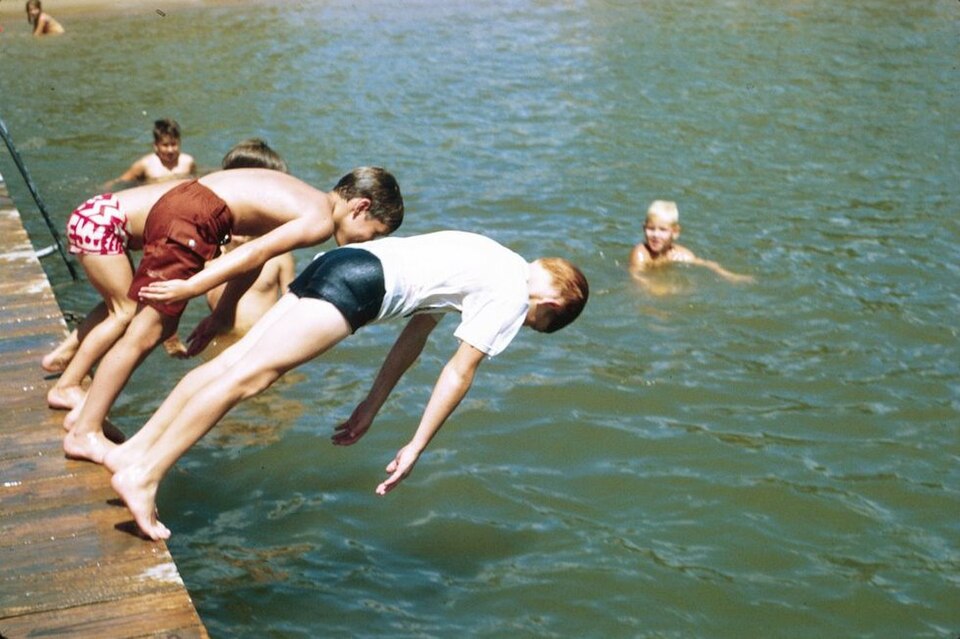
While the adults were busy admiring or tending to the property, the children taught us how to revel in the cottage life, how to hook sunfish and play badminton, how to do a back flip off a canoe. They were an amazing species, those cottage-kids. Unlike our soft and pale flesh, their skin was an unburnable north-woods brown, the soles of their feet toughened yellowed pads indifferent to the sharp sticks and cones of the forest. They lived in swimsuits—the girls with the smooth slippery chests of water nixies, the boys with the puckered genitalia of elves. They knew the way to effigy mounds, to trails that secreted off to ponds wreathed with jewel weed and painted turtles. They could start a boat motor with enviable nonchalance—and sometimes, while speeding around the lake, they’d stop to show us the curious sight of a local marina.
There were two kinds: the corporate variety with its huge outbuildings and rectilinear maze of piers, and the second kind, the ones I remember best—the mom-and-pop operations with their old Coca-Cola coolers humming beside the bait tanks. After topping up on “white gas,” we’d stomp down the pier and poke around. All those little two-bit marinas were very much alike. Not really gas stations, they still resembled their brethren along the highway. It was as if they were a sort of cleaving species of gas station, of winged horse and yellow shell, slowly returning to the water. Most were built of cinderblock—generally painted a thick white with meaty red trim. The border stones around the gravel lots were also painted. You could ease a pen-knife along the ridge of any one stone and turn up rich creamy curls.
Inside was the cold wet fragrance of galvanized metal and the strong hiss of aerating water. We’d peek into every tank—at the silvery froth of minnows, the flatheads and chubs, and finally at the suckers, good-sized in their own right, finning in a place like small black torpedoes. Across from the real McCoys we confronted the strange region of artificial bait; we’d plunge our hands into the bins of bobbers, the tubs of rubber worms. We’d marvel at the Klee toys—the spinners and Tally-wackers, the Boot-tails and Micky Finns. They were pretty to look at and wiggle. Sometimes, as their hooks swung, the barbs would catch on my skin as delicately as the tip of a thistle. If I was careful I could release the bait and raise my hand, palm-down, to see all the hooks and colors dangling ludicrously from my pulling skin.
In the long summer evenings it was the custom of cottage families and their guests to go down to the water and watch the lake grow quiet—lakes called Blue and Crystal, Spider, Trout, Raven, Manitowish and Nokomis. Chains of lakes, or ponds in the trees, flowages candled with stumps, each at day’s end spending its breeze rivers and going still. It was then that the lagoons and inlets shone with the deep luster of molasses; a fishing boat, droning plaintively, would cut furrows that, minutes later, slipped glassily through the reeds. The world grew tricky then, doubling itself along the edges; over the lake and trees the clouds looked like banks of trees rimming a lake of sky. As the stars wetted, the sensor lights winkled, catching on the darkness and casting their yellow staves on the water. At those times I wanted nothing more than to sit on the grass among my people and feel the logy, communal affection of a herd about to bed down.
Instead someone always suggested water-skiing. The motion was invariably seconded and the group split: on one spot gathered the revived and daring, while those left were usually the mothers with infants, and the elderly. Summer after summer, I wanted nothing more than to stay ashore: to be pulled by a boat, on deep water at high speed never appealed to my sense of fun; to the contrary, the prospect left me pale. But I could test out neither as infant nor geriatric, and I was too unassured a kid to remain behind in a category of my own making.
Always, some smart-aleck adult began with a dock start. Shoed into a single ski he leapt onto the water and was soon whipping back and forth across the wake, now low on the outside then suddenly ricocheting across the marbled roughage to another region of red glass, As the rope snapped tight, throwing beads of water, I could feel his weight jerk against the thrust of the boat. It was a strange centripetal dance, our boat vaguely planetary as we orbited the lake, the skier a rogue moon flirting with its tether. Finally the drive would arc past the cottage and the skier would toss his grip into the air and skim up alongside the pier to the polite applause of grandmothers.
Then the cottage-kids went. Using trick skis, they’d scream and drag their butts, they’d flip ‘round and ski backwards, or hop over the wake like monkeys. Wrapped in a towel, I watched their antics miserably, or else I stared off at some lone bird circling, watching it with the keen and dazed interest of the condemned.
Too soon, the guests got their licks. My siblings, those old enough, went first—a couple of sisters and a brother. As each took a turn, the host secured the life vest, then tossed the kid into the lake, like bait. Slowly the boat drifted away, motor burbling. From the stern, I watched my sibling, a nub in the distance, arms dutifully extended and ski tips up, drifting like a bobber. Then someone yelled “Hit it!” and the bow lifted mightily. Each sibling, in turn, emerged from the lake, at first wobbling, then fixed on the surface and stiffly triumphant—my sisters pounding straight down the center of the wake, my brother venturing outside with a cautious hop, but soon growing bolder, cutting back and forth like an old cottage-kid.
“He’s down!” someone shouted, and there was the rope skipping on empty water, my brother, that ham, having slipped on the banana of the lake—a sight that I confess I witnessed not without a little relief. But when the boat swung around and the crew pulled him in, I saw to my dismay that he had acquired, like my sisters, that enviable air of accomplishment. The towel he received seemed a sort of trophy, something earned, like the clean robe a boxer steps into after a good fight.
As I was fitted with the clammy life vest, my sisters advised me that irksome goodwill of the newly initiated. The host adjusted the plastic bindings, then over the edge I went. The water, as always, was a shock, but soon it felt warm, warmer than the air, and I tried to keep all but my head submerged. One ski, then the other, was slid into my grasp. As I bobbed in the boat’s reflection, I could hear the lake slopping against the fiberglass hull, like water in a bathtub. For a moment I held the center of attention, treading and spitting, looking up at those huge faces grouped against the sky like the parody of a Flemish painting. But then the boat drifted off, was suddenly small enough to hide behind the palm of my hand.
Paddling around beneath the great dome of the sky, I arranged myself so the rope, that blue fuse, would slide between my ski tips. Soon the grip came hissing up behind me. When it bumped my life vest, I grabbed hold and found myself dragging along, struggling not to spill out of position. When I nodded, the driver punched the throttle. Instantly the water began to change its physics; as I drew up it started to thicken. For a brief moment I was Saint Peter, full of doubt, up to my knees in froth. If my tips didn’t catch, if I didn’t stumble, then the water hardened into a crisp lacquer and I found myself sliding wickedly down a long corridor of bubbles.
Once up, I always had a successful, if graceless ride—though that brief victory was never to transcend those awful beginnings. And never was a single minute of skiing so pleasant as to finally let go of the rope; in the middle of the lake, to skim to stillness then sink with the rhythmic rocking of a falling leaf. As the boat came back, drawing a wide circle around me, I’d hold the skis aloft and wait patiently, as sure as a child at a bust stop. Soon enough, an arm reached to me and I was pulled high up out of the water and set down dripping among the others.
By then, there was always a star or two to look at, and the host would swing around and head in. Wrapped in my towel I’d hunker in the stern and stare at the passing shore, at the skiffs hanging along the piers and the silhouettes of pontoons afloat on their shadow, at the long stretches of forest that reached back immeasurably into their own darkness, and once on an otherwise blackened bank, two sparklers hopping back and forth, back and forth, marking for an instant their small place of safehold in the trees.
Published in Orion Magazine | Spring Issue, 1993 (My first appearance in Orion)
Photo: Superbomba, Wikimedia Commons
0 Comments